Microsoft vs. Oracle: Two Ways to Pay for the AI Buildout
Microsoft and Oracle closed fiscal 2026 a month apart with nearly identical growth rates and opposite ways of paying for the AI buildout, drawn here as income-statement Sankeys.
The AI buildout has two kinds of landlord. Microsoft spent $115.9 billion on property and equipment in fiscal 2026 and covered it from operating cash flow, while Oracle spent $55.7 billion, ran free cash flow $23.7 billion negative, and raised $43 billion of debt to keep building, according to its press release and coverage of the June report. Oracle answers for that bet again on Thursday, when its first-quarter results land after the close. The two fiscal years below ended a month apart and grew at almost exactly the same rate. The resemblance stops there.
---
Microsoft Corporation (MSFT), Fiscal 2026
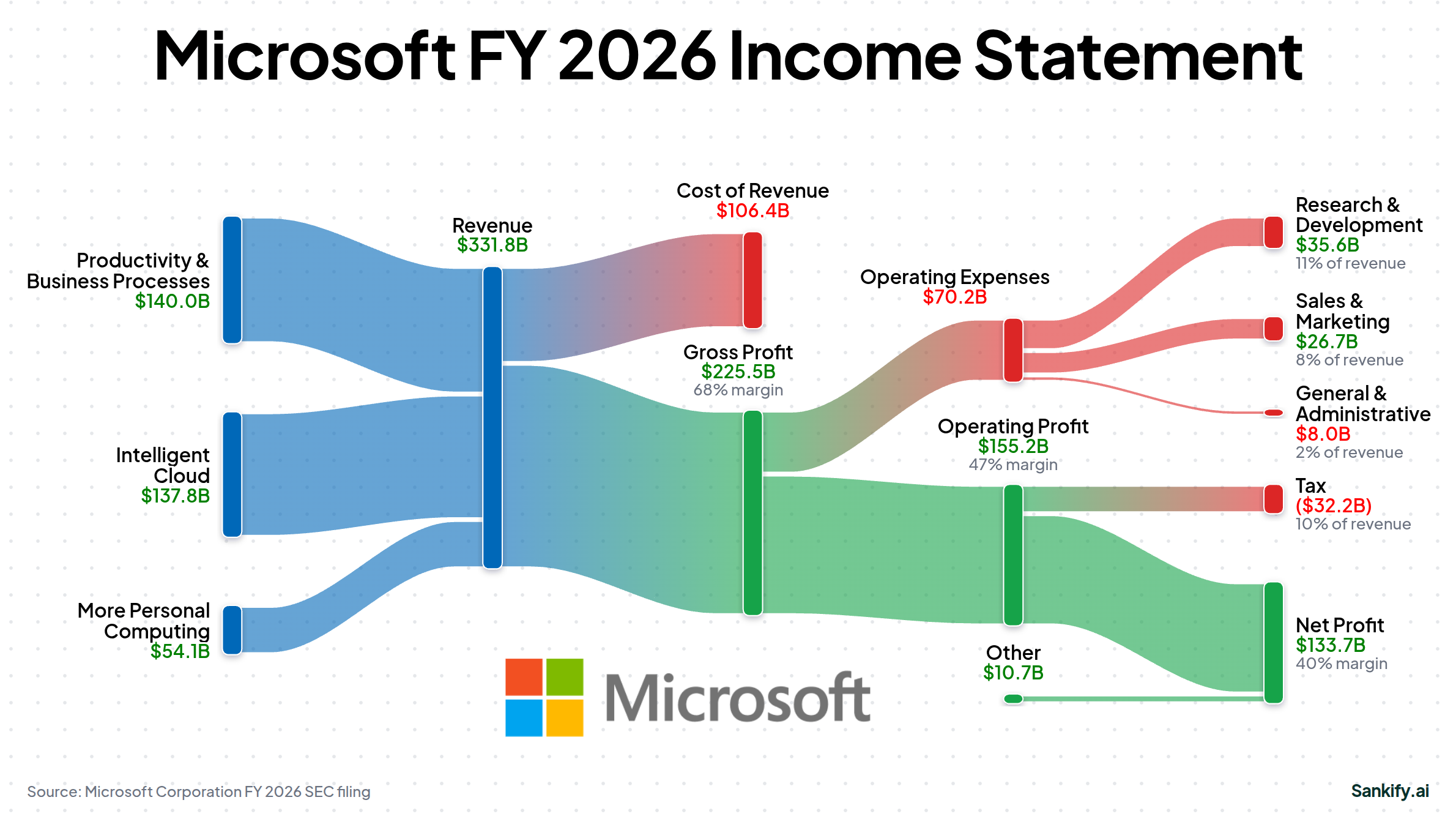
Microsoft Corporation's FY2026 revenue was $332B, up 18% year over year; gross margin 68%; operating margin 47%; net income $134B (40% margin).
Microsoft's chart is the fortress. Gross margin held at 68% even while the company built datacenters at a pace nobody has attempted before, and 40 cents of every revenue dollar came through as net income, $134 billion of it in total. Azure passed $100 billion in annual revenue for the first time, per the press release, with fourth-quarter growth still running at 43%.
Chief executive Satya Nadella told investors the company is advancing the frontier on the cost-to-outcome curve, turning tokens into business results, and the framing fits the numbers. Microsoft Cloud revenue reached $59.3 billion in the fourth quarter, up 27% from a year earlier, per the earnings release. The spending barely dents the margins. That is what a decade-old cloud franchise buys you when the next platform arrives.
Open the interactive MSFT chart →
---
ORACLE CORP (ORCL), Fiscal 2026
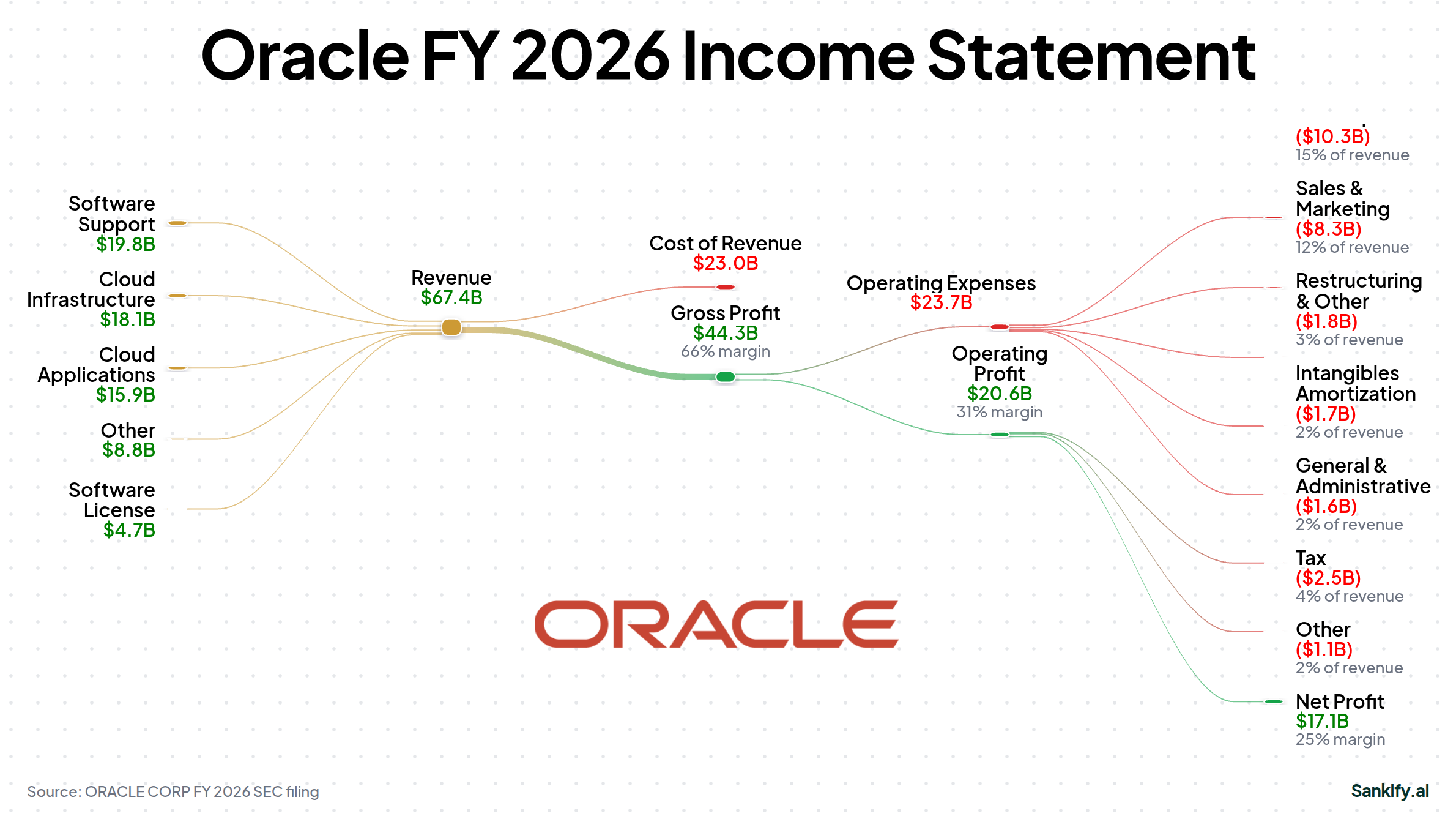
ORACLE CORP's FY2026 revenue was $67.4B, up 17% year over year; operating margin 31%; net income $17.1B (25% margin).
Oracle runs hotter and thinner. Operating margin was 31% against Microsoft's 47%, and net income of $17.1 billion works out to 25 cents on the dollar, yet the growth is coming from the most capital-hungry corner of the business. Cloud infrastructure revenue rose 77% to $18.1 billion in fiscal 2026, per the press release, inside total cloud revenue of $34.0 billion, and the company delivered more than a gigawatt of new datacenter capacity during the year, according to coverage of the earnings call.
The reason Thursday matters is the backlog. Remaining performance obligations ended the year at $638 billion, up 363%, per the press release, including $67 billion of AI contracts signed in the final quarter alone, according to coverage of the call. Turning that paper into revenue is the expensive part. Management projects roughly $70 billion of net capital spending in fiscal 2027 per the same coverage, and guidance calls for about $90 billion of revenue this year, with co-chief executive Clayton Magouyrk telling the call that AI infrastructure makes the existing cloud infrastructure market look small.
Open the interactive ORCL chart →
---
Same boom, opposite balance-sheet postures. Microsoft is funding its buildout from the cash machine it already owns, so the AI cycle shows up in its chart as capacity added without visible strain. Oracle is building the machine and the customer list at the same time, borrowing against a $638 billion order book that dwarfs anything in its history, per the press release, and the roughly 10% drop after the June report, noted in coverage at the time, showed how little patience that structure is granted. Thursday's report will not settle which posture wins. It will show whether the backlog has started to flow.
_Every chart on this page was rendered by Sankify from the company's own SEC filings. Nothing here is illustrative or mocked up._
Visualize MSFT's Income Statement
Transform complex income statements into interactive Sankey diagrams. Understand where the money flows in seconds.
Analyze MSFT